

QuantumScape Q2 2026 Update
An amended collaboration agreement with PowerCo, filed via 8-K, contributed to after-hours pressure on the stock.


Dear Growth Investors,
QuantumScape Corporation, ticker QS, released its second-quarter 2026 business and financial results after market close on July 22, 2026, accompanied by a detailed shareholder letter and an earnings conference call featuring CEO and President Dr. Siva Sivaram and Chief Financial Officer Kevin Hettrich. The update arrived amid heightened investor scrutiny of the company’s path to commercialization, particularly its long-standing collaboration with Volkswagen Group’s battery subsidiary PowerCo SE. While headline financials remained in line with expectations and operational metrics showed continued progress on the Eagle Line pilot facility, an amended collaboration agreement with PowerCo, filed via 8-K and detailed in the letter, drew significant attention. The amendment reduced the maximum aggregate payments under the development program from roughly $131 million to $75.4 million (inclusive of amounts paid to date). This change, combined with the timing of the filing on earnings day, contributed to after-hours pressure on the stock even as management emphasized continuity of strategic objectives, an unchanged $130 million royalty prepayment tied to the separate IP license framework, and no alteration to the 2029 start-of-production target.
My update provides a comprehensive examination of the Q2 results, the PowerCo amendment, new customer traction including the Honda multi-year partnership, expansion into non-automotive verticals, manufacturing and technology progress, financial position and guidance, and management commentary drawn directly from the earnings call. It situates these developments in the broader context of QuantumScape’s multi-year effort to industrialize its proprietary ceramic separator and anode-free lithium-metal architecture.
DISCLAIMER: This review is for informational and educational purposes only and does not constitute financial or investment advice. I hold a position in QuantumScape at the time of writing. All data is sourced from publicly available filings, press releases, and market research. Past performance is not indicative of future results. Investing in stocks involves substantial risk of loss. DYOR!
Background: QuantumScape’s Technology and Commercialization Model
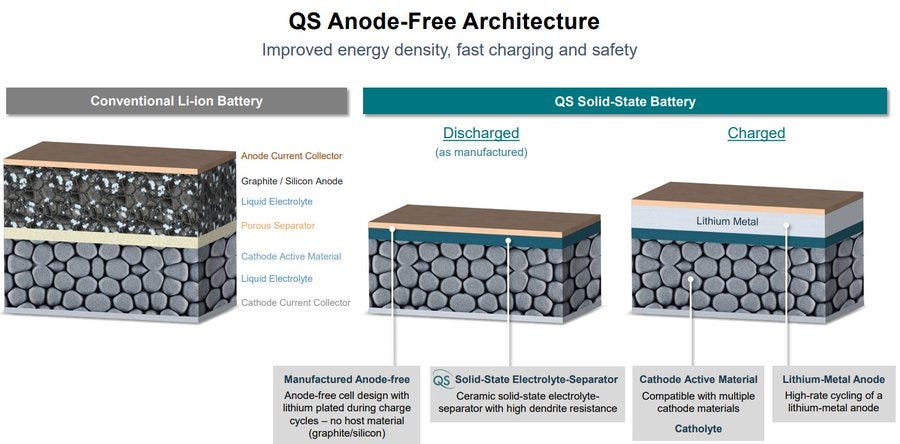
QuantumScape has long positioned its solid-state lithium-metal battery technology as a potential step-change improvement over conventional lithium-ion cells in energy density, fast-charging capability, cycle life, and, critically, safety. The core innovation is a proprietary ceramic solid-state separator that enables pure lithium-metal anodes without the dendrite issues that have historically plagued lithium-metal designs using liquid or polymer electrolytes.
The company has pursued a capital-light licensing and joint-development model rather than building massive factories itself.
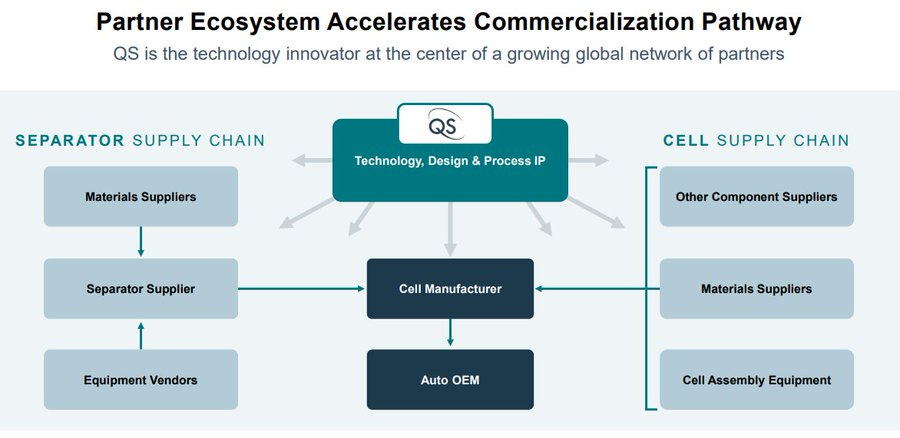
Its primary path to scale has been the relationship with Volkswagen Group, and through PowerCo, entered a landmark collaboration and prospective licensing arrangement in 2024 (later amended in 2025 and again in 2026).
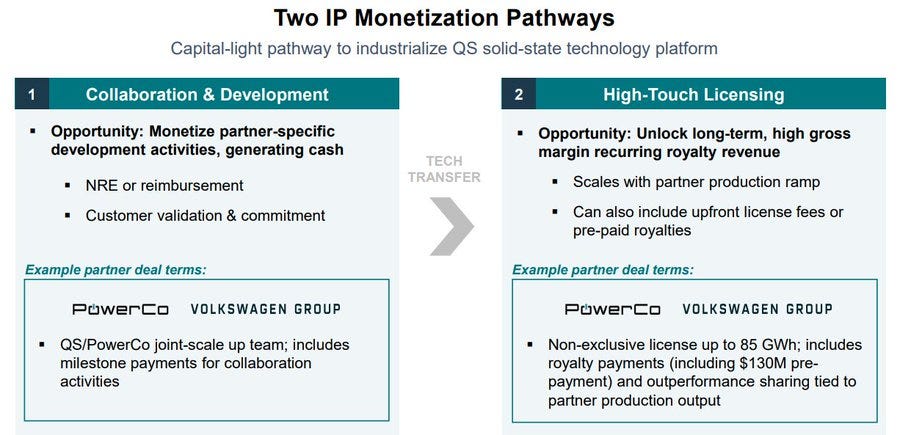
Under the overarching framework, QuantumScape and PowerCo collaborate on development, validation, and initial commercialization of QSE-5 technology cells, with the intention of transferring the technology for high-volume manufacturing by PowerCo. A separate IP license agreement (not yet executed) contemplates a non-exclusive, royalty-bearing license covering capacity of up to 85 GWh per year, of which 5 GWh may serve customers outside the Volkswagen Group. Upon achievement of technical milestones and alignment on production form factor, PowerCo is to prepay $130 million in royalties, credited against future royalty streams.
Parallel to this, QuantumScape has pursued additional OEM relationships, ecosystem partners for materials and equipment (including Murata and Corning for high-volume ceramic separator production via the Cobra process), and, more recently, non-automotive applications.
The company’s pilot production asset, the highly automated Eagle Line in San Jose, California, serves as both a sample-generation facility and a proving ground for processes intended for eventual transfer. Progress on Eagle Line uptime, throughput, process control, and larger-format separators has been a recurring focus of quarterly updates.
Q2 Financial Results and Guidance
For the second quarter ended June 30, 2026, QuantumScape reported GAAP operating expenses of $106.1 million and a GAAP net loss of $98.2 million. Adjusted EBITDA loss was $64.2 million, described as in line with expectations. The company reiterated full-year 2026 Adjusted EBITDA loss guidance of $250 million to $275 million.
Capital expenditures in Q2 totaled just $4.6 million, primarily related to technology roadmap investments and associated facility spending. Full-year 2026 CapEx guidance was lowered meaningfully, from a prior range of $40-60 million to $27-37 million, reflecting capital discipline and cost savings on specific projects. Liquidity at quarter-end stood at $859.0 million, providing a multi-year runway under current spending rates. Management reiterated its intention to remain prudent with the balance sheet while investing in commercialization, new markets, and technology development.
A non-GAAP operational metric that has gained prominence is “customer billings”, defined as the total value of all invoices issued to customers and partners in the period, regardless of accounting treatment. Customer billings were $10.8 million in Q2 and $21.8 million for the first half of 2026. This already exceeded the full-year 2025 total of $19.5 million, allowing the company to declare achievement of its public goal of topping the prior year’s billings. While these figures remain modest relative to quarterly cash burn, the direction, billings from a broadening set of counterparties, aligns with the maturation of the joint-development model. Kevin Hettrich noted on the call that the company had made steady progress, adding ecosystem partners previously and now incorporating Honda as a top-10 OEM following extensive diligence.
The PowerCo Amendment
The most closely examined element of the release was the amendment to the Amended and Restated Collaboration Agreement with PowerCo (originally structured in 2024 and significantly updated in July 2025).

According to the 8-K, the parties updated the program structure and milestones for continued joint development, validation, demonstration, and initial commercialization of QSE-5-based cells, and for transfer into a cell size determined by PowerCo. The amended milestones focus on automotive cell development, larger-format cells, and QuantumScape’s future technology roadmap. The prior statement of work and cost-reimbursement structure was replaced by payments based on achievement of milestones, including delivery and validation of battery cells over the next two years. The maximum aggregate amount QuantumScape will receive from PowerCo under the program is now $75.4 million, inclusive of amounts paid to date. The amendment does not modify the terms of the prospective IP License Agreement. Statement of Work No. 1 was terminated and replaced; outstanding invoiced obligations remain due.
On the earnings call, both executives addressed the change directly and at length. Siva Sivaram stated:
“We recently updated our ongoing collaboration and licensing arrangement with Volkswagen PowerCo with a set of milestones and payments focused on automotive cell development, larger-format cells, and our future technology roadmap.”
He elaborated that “the relationship with PowerCo SE continues to be strong, and the two teams are working closely together on-site here in San Jose. The overall objectives of the collaborations are unchanged. Industrialize the QS technology and transfer the technology to Volkswagen PowerCo for automotive commercialization. Over the past two years, we have continued to update and revise the scope of work as we progress this relationship. The updated scope of work includes milestones related to larger form factor cells, as well as technology elements from QuantumScape’s advanced product roadmap.”
Sivaram further contextualized the annual nature of these adjustments:
“The Volkswagen PowerCo agreements, we update them every year. We have done that three years in a row. As the relationship progresses, we update it based on the milestones yet to come. We have done that consistently. The relationship is very strong. Our objectives remain the same. This reflects that we will be paid based on the milestones that we both have agreed that we need to achieve, which are aligned with our technology roadmap. For instance, the larger-format cell, the future technology milestones that we need to get, etc. There is not anything philosophically different about the objectives of the joint program.”
Kevin Hettrich provided the financial framing: “From a financial perspective, customer billings under the 2025 VW PowerCo collaboration agreement represent a cost share for QS expenses incurred under the agreed scope of work. Under the new scope of work, we’ve tied payments to deliverables aligned to our product roadmap. Additionally, we eliminated MotoE related milestones, given that the organizers put that race series on hiatus. As a result, even though the total possible payments under the agreement have reduced from approximately $131 million to approximately $75 million, we now project significantly reduced expenses for the project. We forecast a net neutral financial impact in terms of cash when compared to the 2025 scope of work.” He confirmed that “the $130 million prepay is unchanged here and is released by technical milestones and alignment on the form-factor. There, as we laid out in the letter, we’ve made nice progress as we’ve outlined with the Eagle Line and also with the demonstration of those larger separators coming off of our Cobra line.”
When asked specifically whether 2029 remained the start-of-production target, Sivaram replied without qualification: “We have not announced any change from our original plans.” On capacity under the prospective license, he noted that the summer 2025 amendment had expanded it to up to 85 GWh, with the incremental 5 GWh permitted for use outside the automotive market within the Volkswagen Group context.
In short, management’s consistent message was that the amendment reflects normal annual recalibration of a multi-year joint program, shifts payment from pure cost-share to deliverable-based milestones (a maturation of the commercial relationship), removes inactive MotoE items, reduces both potential inflows and associated internal expenses on a net-neutral cash basis, and leaves the far larger prize, the IP license and $130 million royalty prepayment, entirely intact. The presence of Volkswagen Group R&D executive Werner Tietz at QuantumScape’s San Jose facility in the days preceding the July 16 signing provided an external corroborating signal that the re-papering was a deliberate, on-site negotiated update rather than a remote or contentious revision.
Honda Partnership and Broader Automotive Traction
Beyond PowerCo, the quarter’s standout commercial announcement was a multi-year partnership with Honda, disclosed on June 18.
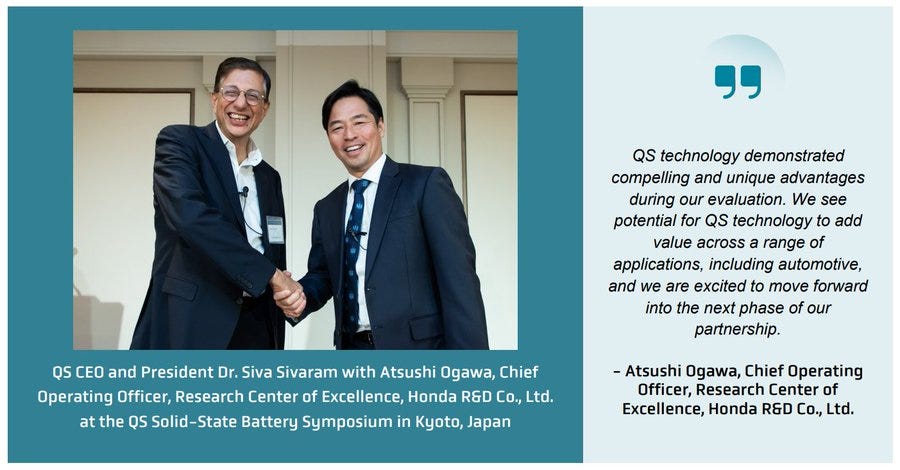
The agreement aims to advance QuantumScape’s solid-state lithium-metal technology for automotive and other applications across Honda’s product portfolio. Honda, a top-10 global automaker with significant existing investments in solid-state battery manufacturing scale-up, subjected the technology to what QuantumScape described as one of the most rigorous assessments to date. Atsushi Ogawa, Chief Operating Officer of Honda R&D’s Research Center of Excellence, was quoted in the shareholder letter: “QS technology demonstrated compelling and unique advantages during our evaluation. We see potential for QS technology to add value across a range of applications, including automotive, and we are excited to move forward into the next phase of our partnership.”
Sivaram highlighted on the call that the partnership “results from one of the most rigorous assessments of our technology to date” and opens pathways into high-value markets given Honda’s diverse portfolio.
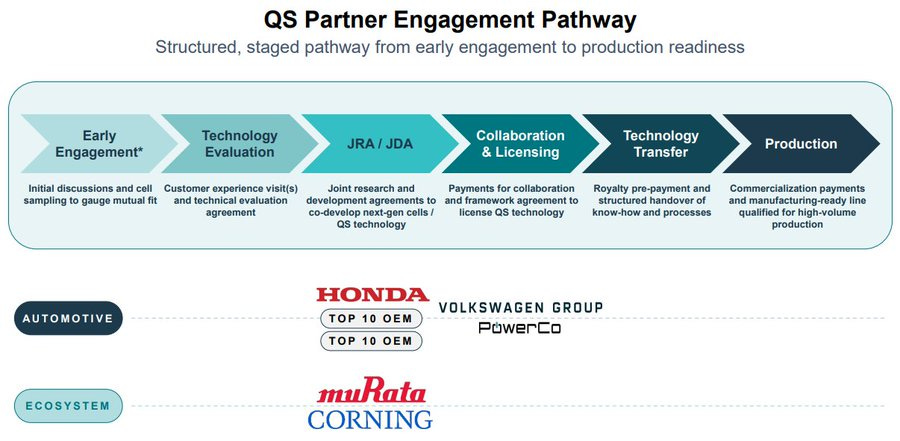
QuantumScape is also working with two other top-10 automotive OEM customers under existing joint development agreements and shipped cells to an additional (unnamed) automotive OEM during the quarter.
Collectively, the company now counts engagement with four of the top-10 global automotive OEMs. The Honda relationship is particularly noteworthy because Honda has already invested in its own solid-state pilot capabilities, and the ceramic separator approach aligns with areas of mutual technical interest. Management indicated the development template refined with PowerCo is being applied more broadly, suggesting emerging repeatability in the OEM engagement model.
Expansion Beyond Automotive: QSEV, QSDC, and QSAS Verticals
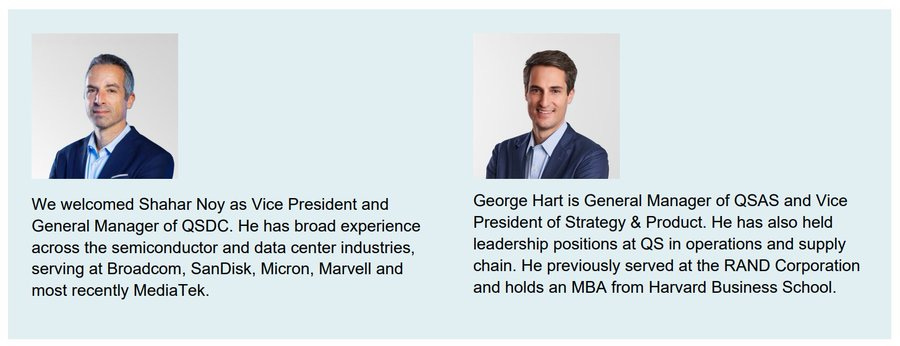
Recognizing broad interest beyond electric vehicles, QuantumScape formally established three business verticals: QSEV (electric vehicles), QSDC (AI data centers), and QSAS (advanced solutions including aerospace and defense). The fundamental technology stack is viewed as applicable across these markets, with tailored go-to-market approaches for each.
QSDC is focused on rapid development of solutions for AI data-center power systems. As rack power demands approach the megawatt scale, legacy designs face limitations; the industry is shifting toward 800 V DC architectures pioneered in automotive. QuantumScape believes its combination of energy density, power performance, and inherent safety offers a compelling proposition. The vertical is engaged with original design manufacturers (ODMs) on designs based on QSE-5 technology. Shahar Noy joined as Vice President and General Manager of QSDC, bringing experience from Broadcom, SanDisk, Micron, Marvell, and MediaTek. Sivaram noted that “announcements are coming with timelines attached,” pointing to the natural deadlines created by the 800 V DC transition and megawatt racks expected to land in data centers toward the end of 2028; an integrated battery product must therefore exist ahead of that window.
QSAS targets aerospace, defense, and other advanced applications where energy density, power, safety, and supply-chain resilience are paramount. Conventional lithium-ion relies heavily on graphite anode material sourced predominantly from China; QuantumScape’s anode-free lithium-metal architecture eliminates that dependency. The vertical recently shipped QSE-5 cells to a major American defense prime contractor and is engaged with global aerospace and defense players. George Hart serves as General Manager of QSAS and Vice President of Strategy & Product. Higher Eagle Line output enabled these early shipments.
Eagle Line, Cobra Process, and Technology Validation
Operational progress on the Eagle Line remained a centerpiece of the update. Core tools are demonstrating uptime greater than 90 percent, key productivity metrics are meeting targets, and cell volumes are ramping with sample shipments underway. The company aims to double cell output in the second half of 2026 and expects customer sample shipments to accelerate across all three verticals. Sivaram described the integration work completed since the line’s release in February and the ongoing focus on process stability and control that underpins the volume increase and technology-transfer readiness.
On the separator front, the Cobra process has demonstrated the ability to produce larger-area separators suitable for higher-capacity cell designs. Larger-format cells improve packaging efficiency and can raise cell-level energy density, precisely the direction reflected in the updated PowerCo milestones. Collaboration with Murata and Corning continues toward high-volume ceramic separator production.
Safety validation has also advanced. Customer feedback consistently highlights the value of the nonflammable, noncombustible ceramic separator relative to next-generation approaches that retain liquid electrolytes with silicon or lithium-metal anodes. Larger-scale testing enabled by increased QSE-5 output, covering nail penetration, external short circuit, and thermal stability up to 300 °C, has replicated earlier findings. Management asserts the design is fundamentally safer than both conventional and competing next-generation lithium-ion cells.
Ducati Program: Elimination of MotoE-related Milestones
One key change was the elimination of MotoE-related milestones. CFO Kevin Hettrich explained that these were removed because the organizers placed the MotoE electric motorcycle racing series on hiatus. The Ducati V21L prototype, powered by QS QSE-5 cells, had served as a high-visibility demonstration platform in 2025, but the pause in the race series made the associated contractual milestones unnecessary.
The Ducati V21L prototype (a MotoE-derived electric race motorcycle) served as the platform for the world’s first live public demonstration of QuantumScape’s QSE-5 solid-state cells in a vehicle. This occurred in September 2025 at IAA Mobility in Munich, in collaboration with PowerCo and Audi (which designed the battery pack). The cells were produced using the Cobra process, showcasing high energy density, fast-charging, and power capabilities in a demanding racing application.
Putting the Pieces Together: Thesis Continuity
Taken as a whole, the Q2 update presents a coherent picture of a development-stage company advancing on multiple synchronized fronts. The PowerCo relationship, while restructured on payment mechanics and near-term scope, retains its original industrialization and technology-transfer objectives, the full $130 million royalty prepayment pathway, the expanded 85 GWh licensing capacity framework, and the 2029 production timeline. Honda’s entry as a multi-year joint research partner adds a second major OEM template. Billings have already surpassed the prior full year. Liquidity remains robust at $859 million, CapEx guidance has been reduced, and Adjusted EBITDA guidance is unchanged. Eagle Line productivity supports both customer sample flow and process learning, while larger separators and safety data address key customer requirements. Non-automotive verticals have moved from conceptual slides to actual cell shipments and active ODM/defense-prime engagement, with concrete market deadlines (data-center 800 V / megawatt transition by late 2028) providing external pacing.
The reduction in the PowerCo development-program ceiling from ~$131 million to $75.4 million is a real numerical change and understandably prompted questions. Management’s explanation, that the shift to deliverable-based payments, removal of inactive race-program milestones, and corresponding reduction in QuantumScape’s own project expenses produce a net-neutral cash impact, is internally consistent and was delivered transparently on the call. Whether investors fully accept that framing will be tested by future milestone achievement rates and cash-flow disclosures. Separately, the annual cadence of agreement updates, the on-site presence of senior Volkswagen Group R&D leadership immediately preceding the signing, and the explicit preservation of the license economics argue against interpreting the amendment as a signal of fundamental delay or diminished commitment.
QuantumScape remains a pre-revenue company with substantial quarterly losses and the inherent risks of first-of-a-kind technology scale-up, process control, equipment reliability, customer qualification cycles, and competitive dynamics in next-generation batteries. The path from pilot samples to licensed gigawatt-hour production is long. Yet the Q2 disclosures, the management commentary, and the pattern of customer expansion collectively indicate that the core elements of the commercialization thesis, technology performance and safety differentiation, a leading automotive OEM partner advancing toward industrialization, broadening customer traction, and a capital structure sufficient to reach key milestones, were not impaired by the quarter’s results or the PowerCo re-papering.
As Siva Sivaram and Kevin Hettrich repeatedly underscored, the objectives of the joint program with PowerCo have not changed philosophically, the royalty prepayment mechanics remain intact, production-start guidance is unchanged, and operational execution on the Eagle Line continues to improve. For long-term shareholders focused on the eventual royalty stream and multi-OEM licensing potential, the quarter reinforced rather than revised the fundamental trajectory.
I am not buying additional shares at this time. The core investment thesis remains fully intact: the PowerCo license and $130 million royalty prepayment are untouched, the 2029 production target has not changed, Honda has joined as top-10 OEM partner, customer billings are accelerating, and Eagle Line/Cobra progress continues to support larger-format cells and technology transfer. I will hold my existing position and watch the upcoming technical milestones closely, particularly larger-format cell validation, further Eagle Line volume ramp in H2 2026, and any concrete timelines from the QSDC and QSAS verticals.
Sources: https://ir.quantumscape.com/static-files/ddd4e2ca-d529-4389-be02-ba6192bac4a0